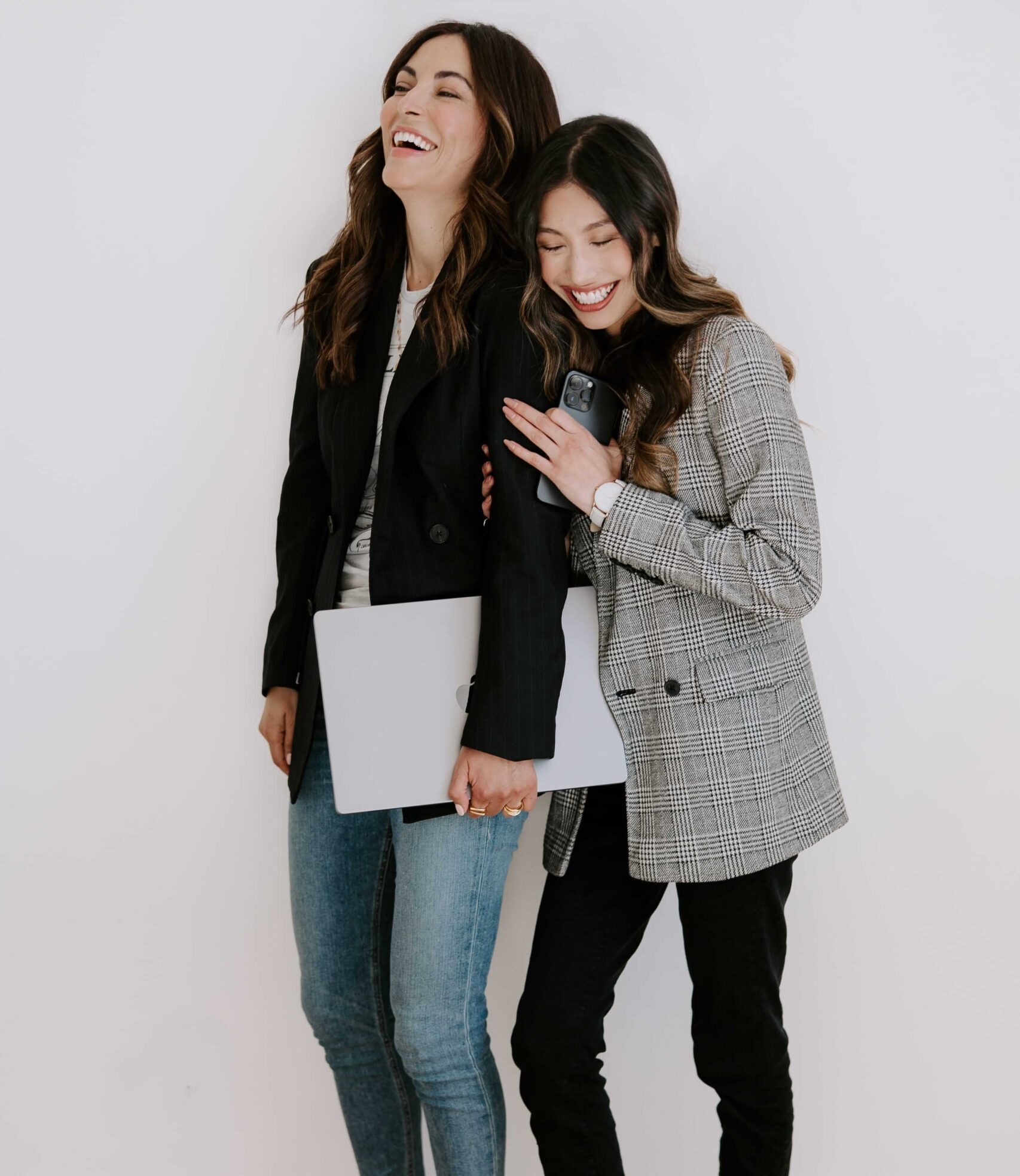

Hello, nice to meet you, I’m Jen—former email marketing hater.
Two years ago, email marketing was my least favorite thing I did for our business. And it definitely wasn’t generating a giant chunk of our revenue.
In fact, while I knew we “had to have an email list” because blah blah, there’s no algorithm, you don’t have to dance and point in the inbox, etc., I could never think of anything to write about and thus, either sent NO emails or hated what we did send. Fun!
But then something magical happened.
One day, during the first of 19385 days in quarantine, I was bored. And instead of writing our typical “5 quick ways to make your website better!” email, I got distracted by our ugly email signature and wrote this weirdly long, random, not at ALL marketing-y email about procrastination, email signatures, and Nick Miller from New Girl (weirdly hot, right?).
It didn’t look pretty, there were 0 buttons, no fancy email newsletter layout—but it was fun to write (I’d kind of forgotten I love to write), it made me laugh, and it was sort of helpful? So I hit send and walked away.
And… holy crap. I never expected the response I’d get.
As it turns out, everyone ELSE was *also* bored in quarantine, procrastinating, hated their email signatures, needed to discuss Nick Miller, and wanted something funny to read?
Our inbox *exploded.*
And in that one moment, our entire approach to email marketing changed. Heck, our entire business model — and revenue — changed. Our boring sales emails transformed into a famous (kinda weird) newsletter responsible for generating multiple 7-figures in two years.
Email is now THE most powerful tool in our business. It’s also the most enjoyable.
It went from a chore I dreaded to the highlight of my week (And many of our #longandweird subscribers’ weekly highlight, too. 🤗)
And when we finally decided to use our email newsletter to sell, it WORKED.
& even better? Writing content for our subscribers feels easy, now that we know our audience is much more interested in real-life rambles than the perfect, curated “tips and tricks” that they’re bombarded with on every other marketing platform.
If I have a weird experience at the grocery store? Newsletter. That time I got stuck in Panama? Newsletter. Crazy pest control guy? Newsletter.
(“I bet THIS is going in the newsletter!” = a phrase I hear a lot!)
Everything suddenly turned into email newsletter content in my mind, and TONIC has been reaping the rewards ever since—so I figured it’s time for me to share the “how to” of it all, since so far all I’ve done is tell you what not to do.
In our last post, I showed you a little bit about how it worked, but now I want to walk you through the strategy involved.
So, you want to stop writing boring emails (and fall in love with email marketing for good)?
Then you’ll have to ditch the digital marketer jail.
You know, that place you land when you don’t send enough giant buttons or calls to action or spotlights on that one product you’re dying for your audience to buy.
Instead, you’ll have to venture off into the world of the unknown and consider writing what you actually want to say, because chances are, your subscribers are as sick of the typical marketing content as you are.
No one wants to read the email you think you should write; they want to hear what you really think, what you bought, that embarrassing story, what you’re learning, experiencing, hating, feeling…
They want the details that create memorable, relatable personal connections.
5 Ways To Write Email Newsletters and Keep Your Readers Engaged
#1 – TELL BETTER STORIES
My simple, yet absolute holy grail advice for great emails? Start telling great stories.
Here’s why: no matter how busy your audience is, they’ll make time for great stories.
Sure, they may be extremely overbooked and stressed out, but they’ll welcome the distraction—because stories stick, and stories connect.
They get retold, passed down, and ultimately, remembered. (Um, Super Bowl commercials have a giant budget for a reason.)
One of my favorite studies shows that messages delivered as stories are twenty two times as memorable as facts.
Not to get all science-y on you, but when we read a good story, our brains actually release oxytocin (the happy bonding hormone) which means suddenly, we CARE about the people involved.
This is why every-politician-ever invents a story about “little Rhonda from Iowa” when they really just want to make a point about, like, corn zoning laws.
If you want people to read your emails, stop making them READ and start making them CARE by telling a story.
Your email newsletter subscribers don’t care nearly as much about “ways to grow your affiliate income” as they do about that time you arrived in Paris with only a breast pump to your name.
Email feels like a chore, stories feel like a break.
#2 – GET PERSONAL
Here’s a secret about email that most big brands have yet to figure out: we almost never want to read an email from a brand (anyone else immediately send them straight to Trash?) but we DO want to get letters from our friends.
That means that all you have to do to stand out from 99% of marketing emails is make things more personal.
People want to connect with people. And people want to buy from people.
I’m sure you’ve experienced this phenomenon in your own life plenty of times. Don’t you feel so much better about your purchase when you know exactly who your money is supporting?
(Do I suddenly feel like I’m saving the world one mom-and-pop shop at a time when I #ShopLocal on Small Business Saturday? Absolutely yes, I do.)
Marketing in your email newsletters shouldn’t feel like marketing if you care about helping your subscribers get to know you—not your brand, YOU.
Email is the best place for building authentic connections, because of the nature of how the content is delivered; it’s a one-on-one conversation inside their inbox.
So, treat it as such, and email the kind of content only you can create: interesting, funny, breezy, casual, vulnerable, thoughtful, personal.
The content that comes from your life and your story and your experiences will perform much better—and will foster deeper connections with your community—than any traditional email from a brand ever could.
(No one would read my emails if they came from Tonic Site Shop, but now thousands upon thousands of people open all of my #longandweirds because it comes from Jen.)
#3 – WRITE THE KIND OF EMAIL YOU’D ACTUALLY WANT TO READ
If you wouldn’t want to read your emails, why would anyone else?
When I hated email, this was the issue. I knew *I* wouldn’t have wanted what I was sending, therefore I wasn’t motivated about sending the content at all. My heart wasn’t in it, because I knew their eyes wouldn’t be on it.
It was boring.
If you’re gonna take up space in someone’s inbox, add value.
When you email just to email—or worse, just to sell something—your subscribers’ interest starts to wane off, until they eventually X out and move onto the next just-like-everyone-else brand taking up space in their inbox.
But when you provide something insightful, inspirational, informational, inspiring, or—our personal favorite—entertaining, you’re able to capture (and keep!) their attention much easier.
Remember: there are no specific rules to follow to write the best email newsletter for your business. You don’t have to do what all the other brands are doing.
(And, just in case you haven’t caught on by now, we’re telling you that you shouldn’t.)
Simply follow your interests and create the content you’d actually like to consume, and it’ll magically make you want to create more!
→ Quick tip before we move on: if you want to write better emails, start with reading better emails. My personal favorites are from Laura Belgray, Cole Schafer, and James Clear.
#4 – STOP WRITING LIKE A WEIRD ROBOT HUMAN
I know, sorry, I’m calling you out, but honestly, would you EVER say “I have an exciting new offer to share with you, Jennifer!” to a friend across the table at a coffee shop?
(I sure hope not.)
Instead, what you’d probably say is something more like “ahhh Jen! I’ve been working on this for month and it’s FINALLY here!”
But, for some odd reason, as soon as most people feel like they need to be “professional” they turn into weird, impersonal robots writing stiff, awkward (boring) phrases they’d NEVER say in real life.
#5 – START IN THE MIDDLE
Most boring emails start out the same way:
“Hi Jennifer, I want to tell you about something crazy that happened this week. I could hardly believe it!”
Nope, sorry. All of that copy is unnecessary, and I’m already bored.
Try this instead:
“Hey, Jen! My friend Alex has a habit of befriending random bartenders, and sometimes it gets her everyone in trouble. This was one of those times…”
You want to see how that story ends, right?
No one wants to hear about the story you’re going to tell—don’t make them unwrap the Amazon packaging to get to the product.
By starting in the middle of the story, you’ll be able to hook your reader’s attention so they can’t WAIT to read on and find out what happens.
I always go back to this favorite copywriting tip: “if they don’t read your first line, they won’t read your second one, either.” And that 100% applies to writing email newsletters; capturing attention immediately is the only way you’ll get them to keep reading.
And speaking of…
RE: How To Write Email Newsletter Subject Lines
Getting your subscribers to open your email newsletters is just as important as getting them to read them all the way through, and that responsibility falls on the shoulders of your subject lines.
With limited space—41 characters total, but 16 characters being the optimum amount for conversion—you don’t have much to work with in terms of convincing your subscribers to open your emails, so every word counts.
But that’s not a problem for you anymore, now that you know that (pretty much) all you have to do is put yourself in your reader’s shoes & consider what would make YOU want to open an email.
(“Um, Jen, do you have any more concrete tips than that?”)
According to email marketing powerhouse Mailchimp, the best subject lines are short, descriptive, personalized (use the reader’s first name!), limit punctuation, and use emojis carefully.
Thanks, Mailchimp. My less-confusing tip? Open a curiosity loop.
Almost all of our most effective subject lines have one thing in common — your brain HAS to know what happens next.
For example, a recent SL that crushed it for us?
“Start with a dead body?”
Think of the sheer number of questions your brain generates after reading that.
Start what?
Who’s dead?
Why is this a question? This hasn’t been decided?
Why is Jen talking about murder in a Friday email?
Scientists have found that when confronted with something that creates curiosity, your brain actually releases increased dopamine (the pleasure chemical) and there are increased pathways to the reward center of your brain that go off when you find the “answer,” and triggers the hippocampus, which leads to increased memory for whatever you’re discovering.
Simply put, your brain literally THRIVES when it’s following curiosity. Open a curiosity loop in your subject line and people can’t help but find out more.
RE: How To Send An Email Newsletter
Alright, alright, alright — now you know how to: tell better stories, get personal, write the kind of email you’d actually want to read, stop writing like a weird robot human, and start in the middle.
Now it’s time to get your stories out into the world! Our go-to for anyone looking to get started with email marketing is Flodesk. We hate designing marketing emails because let’s be real, it’s hard to make email newsletters look pretty. And then FloDesk came in and saved the day by making email easy and pretty. We call that a win-win! Tonic Regulars save 50% with this link.
RE: Email Newsletter Examples
Subscribe to get more non-boring email newsletters delivered to your inbox 😏 Or, if you can’t wait til our next #longandweird goes out, read the series that started it all, Jennifer In Paris, right here!